When you start shopping for rucking gear, you quickly run into a choice that trips up almost every beginner: do you want a compact plate carrier, or a full-size rucking backpack? They look different, they carry weight differently, and the wrong pick can leave you either overloaded with a giant bag you don’t need, or squeezing 45 lbs into something built for half that.
The good news is that the right answer is usually pretty clear once you know how you’ll actually train. In this guide we’ll break down the two formats, who each one suits, and how to pick the one that fits your body, your load, and your goals. This is about the style of pack, not the brand, so it works whichever company you end up buying from.
The two formats, explained
Almost every rucking setup falls into one of two camps.
A plate carrier is a compact, minimalist pack built to do one thing: hold a weight plate high and tight against your upper back. There’s little or no storage, no room for a laptop or a change of clothes, just a snug carrier that keeps the load close to your spine so it doesn’t bounce. Think of it as the “sports car” of rucking gear: focused, light, built for the activity and nothing else.
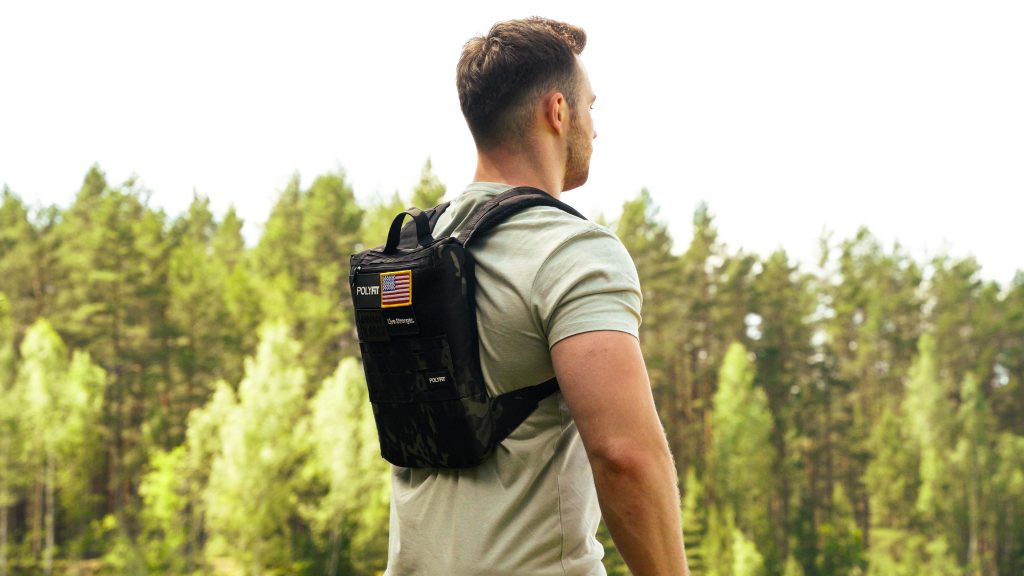
Reference Photo for Plate Carrier: Polyfit Rucking Backpack 2.0
A traditional rucking backpack is a full-size pack with real cargo space, a structured frame, and often a hip belt. It holds a plate too, usually in an elevated pocket, but it also carries water, snacks, layers, and gear. It’s heavier and bulkier, but it does far more than just carry weight. This is the “SUV”: bigger, more capable, ready for longer or heavier missions.

Reference Photo for Traditional Rucking Backpack: Joey Cedé Photography on Pexels.com (wearing Rugsak)
Summary: A plate carrier is a compact, plate-only setup that keeps weight high and tight. A traditional rucking backpack adds storage, structure, and usually a hip belt, at the cost of more bulk. Same goal, very different tools.
How much weight are you carrying?
This is the single most important question, and it settles the choice for most people.
If you’re rucking with roughly 10 to 40 lbs for fitness, walks, or everyday training, a plate carrier is usually all you need. The weight sits high and stable, the pack stays out of your way, and you’re not hauling around empty cargo space you’ll never use. Most fitness-focused ruckers live happily in this range for years.
If you’re regularly carrying 45 lbs and up, the maths changes. Compact plate carriers top out fairly low and often lack a hip belt, so heavy loads press down hard on your shoulders. A traditional backpack with a frame and a hip belt spreads that weight onto your hips, which is far more comfortable over long distances and heavy loads. If you’re training for a military event, a rucking challenge, or multi-hour efforts under serious weight, the bigger pack earns its keep. Not sure where you should land? Our guide on how much weight to carry when rucking will help you set a sensible target.
Summary: Carrying 10–40 lbs for fitness? A plate carrier is plenty. Regularly going 45 lbs or heavier, or training for events? A traditional backpack with a hip belt will carry it far more comfortably.
Body size and fit
Weight isn’t the only factor, your frame matters too.
Compact plate carriers are designed to sit close and snug, which works beautifully for smaller and average builds, and they’re a popular choice for women who find full-size rucks too bulky and boxy. Options like the Polyfit Rucking Backpack 2.0 are built around exactly this compact, easy-to-wear profile, and land at a beginner-friendly price too.
Taller and larger ruckers, on the other hand, sometimes find compact carriers a little cramped across the shoulders. If you’re over six foot with a broad frame, a full-size pack like the GORUCK Rucker or a 5.11 RUSH often gives a roomier, more natural fit, along with the extra capacity to match.
Summary: Compact carriers suit smaller and average frames, and many women prefer them. Taller or broader ruckers often get a better fit (and more room) from a full-size backpack.
Do you need to carry anything else?
Here’s a question people forget until they’re already out walking: where does your stuff go?
A plate carrier holds a plate and little else. That’s perfect if you’re doing a quick neighbourhood loop, a treadmill session, or a workout where you don’t need to bring anything. But if you want to carry water, snacks, an extra layer, or gear for a longer day out, you’ll be stuck.
A traditional backpack solves that instantly. It doubles as a hiking pack, a travel bag, or an everyday carry, so if you want one bag that ruck and does everything else, the full-size format wins on versatility.
Summary: Plate carrier = weight only, ideal for short focused sessions. Traditional backpack = weight plus storage, better if you need to carry gear or want one do-it-all bag.
So which should you buy?
For most people getting into rucking for fitness, a compact plate carrier is the smart starting point: it’s affordable, comfortable, keeps the weight where it should be, and doesn’t burden you with bulk you won’t use. If you want the best value in that format, the Polyfit Rucking Backpack 2.0 is a strong pick, and you can see how it stacks up against the premium option in our GORUCK vs Polyfit comparison.
Step up to a traditional rucking backpack if you carry heavy (45 lbs+), you’re taller or larger and want a roomier fit, you need cargo space, or you want a single pack that handles rucking, hiking, and travel all at once. The full-size GORUCK Rucker is the benchmark here.
The honest truth is there’s no universally “better” format, only the one that matches how you train. Start with your weight and your goals, and the right pack picks itself. And if you’re still deciding between a pack and a vest altogether, our rucking backpack vs weighted vest breakdown is worth a look before you spend.